“Whatever may come or now be made of our Camp Logan, we never can escape the fact that once upon a time…the very heart of our nation beat within this sphere.”
—Ilona B. Benda, 1923
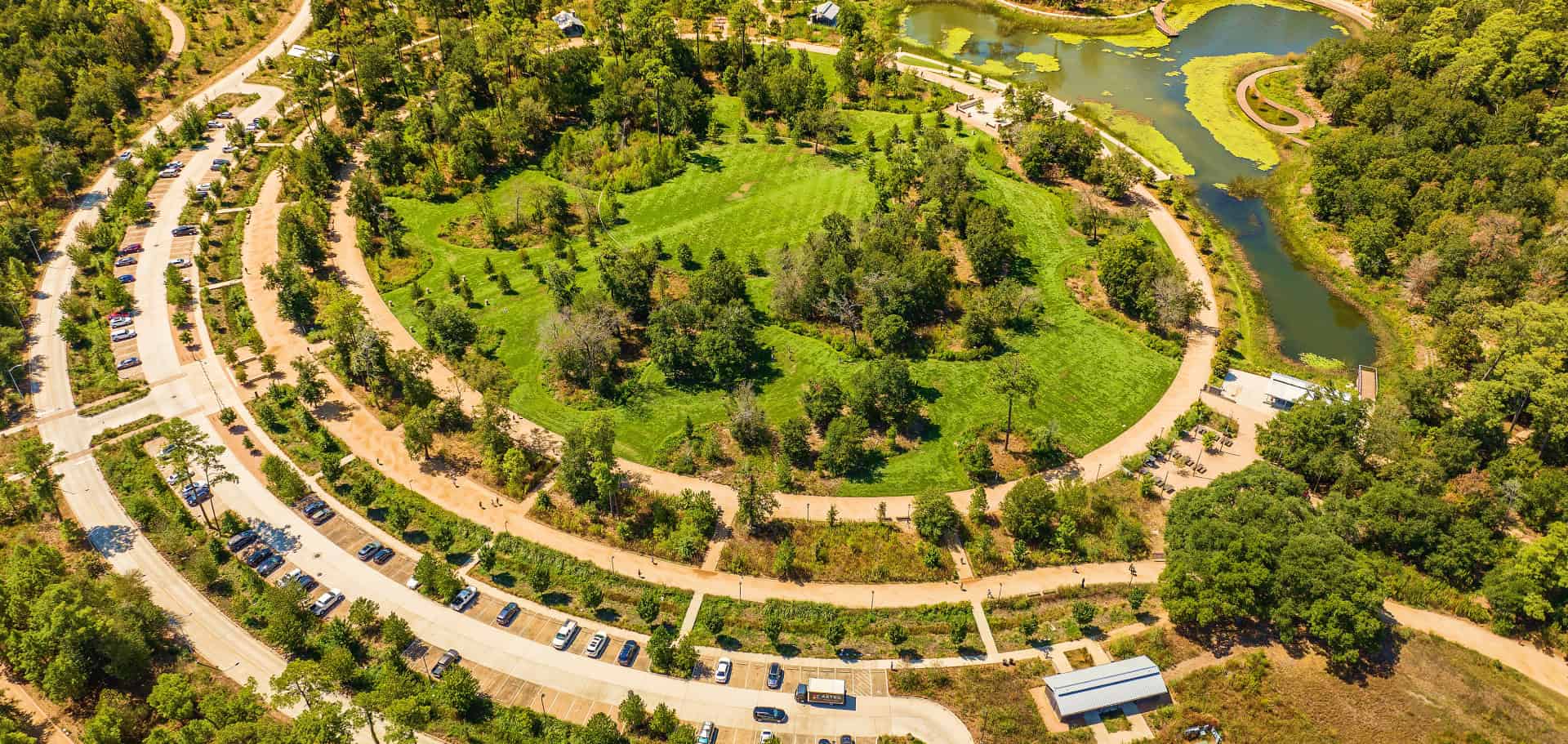
Memorial Groves marks the next milestone in the implementation of Memorial Park’s visionary Master Plan. Located on a narrow stretch of land between the Union Pacific rail line and West Memorial Loop Drive, this site was chosen for having the greatest number archaeological remnants from Camp Logan, the World War I training camp on which the Park now sits. Many, if not most, Houstonians do not know the history behind Memorial Park—nor how it came by its name. With a living memorial of nearly 3,000 bald cypress trees, a new visitor center, trails, and spaces for reflection and recreation, Memorial Groves will be the heart of this story within Memorial Park.
A Memorial Park Master Plan and Ten-Year Plan Project

Learn more about Memorial Park’s past, present & future

More Information
ABOUT THE PROJECT
Established in 1924, Houston’s Memorial Park was named to honor the 70,000 soldiers who served at Camp Logan, a U.S. Army training camp during World War I (WWI). The Park’s creation was driven by a campaign from Houstonians, led by Ilona B. Benda, Ima Hogg and Catharine Mary Emmott, to “remember the boys” by acquiring the site and transforming it into a public park. Will and Mike Hogg, with minority owner Henry Stude, bought two tracts of the former Camp Logan land and sold the acreage to the City of Houston at cost. In May 1924, the City officially established Memorial Park in memory of the soldiers. Today, approximately 1,500 acres of the original 7,600-acre training camp comprise Memorial Park.
Now, more than a century later, Memorial Groves will honor all who contributed to the war effort at Camp Logan. This includes those who trained there, such as the U.S. Army’s 370th Infantry Regiment and the Cavalry, the local organizations that participated in camp life, like the YMCA, as well as the 24th Infantry Regiment, who oversaw construction of the camp.
Accelerated by generous support from Kinder Foundation ($10 million), John L. Nau III ($7.5 million), Brown Foundation ($7.5 million), and the Jerold B. Katz Foundation ($7.5 million), this $50.5 million project is the latest of several transformative improvements envisioned by the Memorial Park Master Plan for the revitalization of Houston’s largest urban greenspace.
Through their design for Memorial Groves, Nelson Byrd Woltz Landscape Architects will create a place-based, interactive experience that not only honors Houston’s World War I history but also serves everyday park users.
Memorial Groves is located on a narrow tract within Memorial Park running north to south primarily between the Union Pacific rail line and West Memorial Loop Drive. This site was chosen because it holds the greatest number of archaeological remains from Camp Logan structures within the Park, providing an opportunity to convey the scale and scope of Camp Logan’s footprint as well as its legacy.
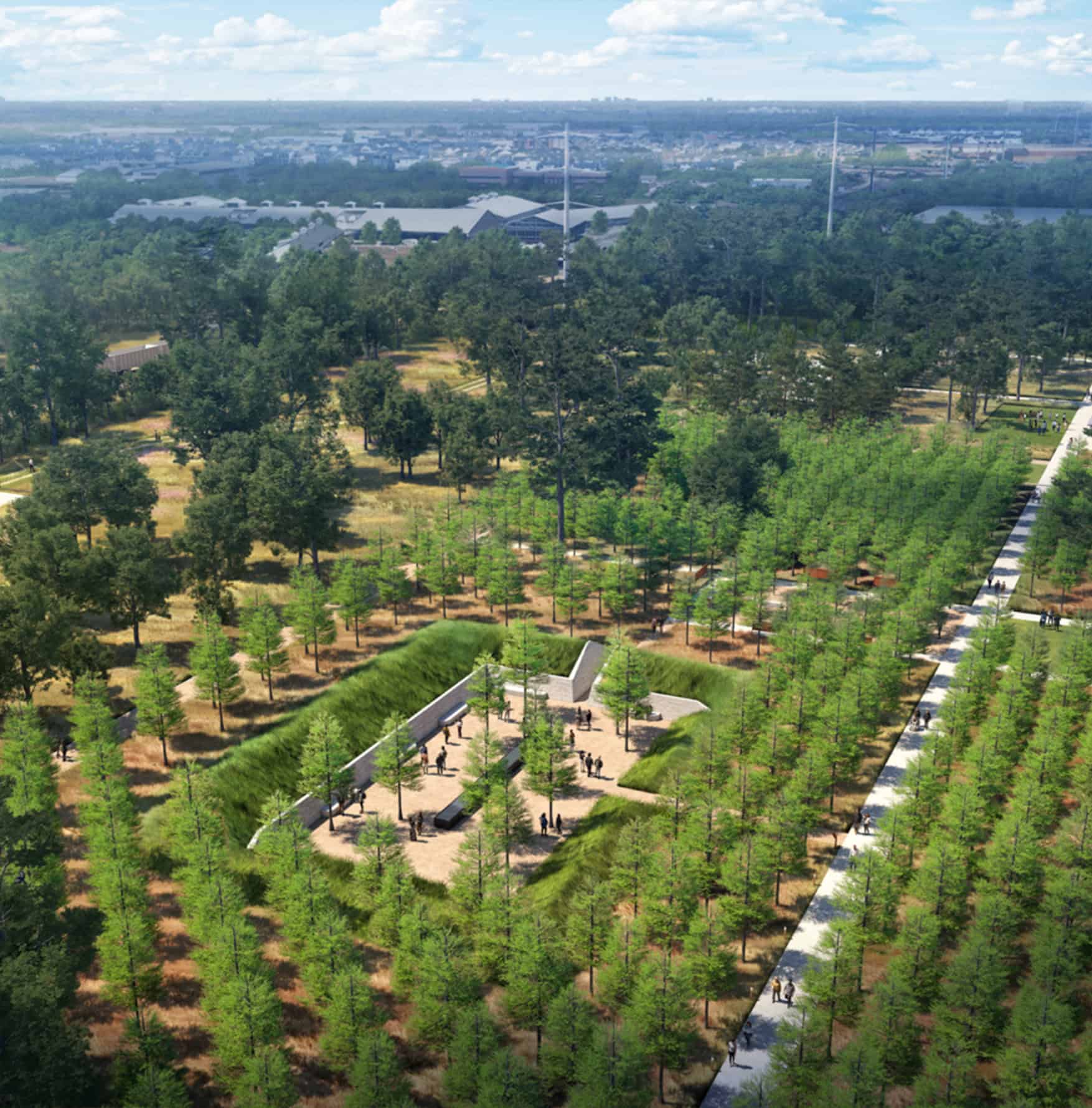
Visitors will learn about the lives and daily routines of the camp’s soldiers as they view the unearthed foundations of camp buildings that lie between two important native habitats: an existing prairie, which will be protected and preserved, and a twenty-acre expanse of savanna habitat that will be restored as part of the project.
A Living Memorial
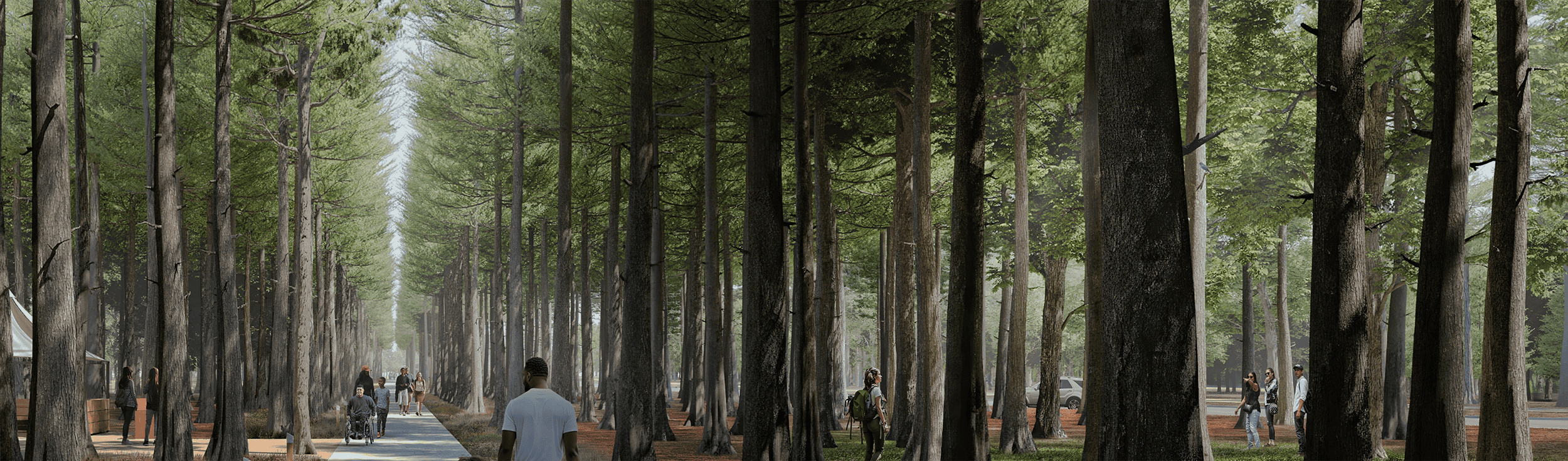
The design of Memorial Groves seeks to create a living remembrance: a forest of nearly 3,000 bald cypress trees planted in a rigorous grid. Symbolizing soldiers standing in formation, the grid of trees will form long lines, their straight columnar trunks creating tall cathedral-like spaces over time.
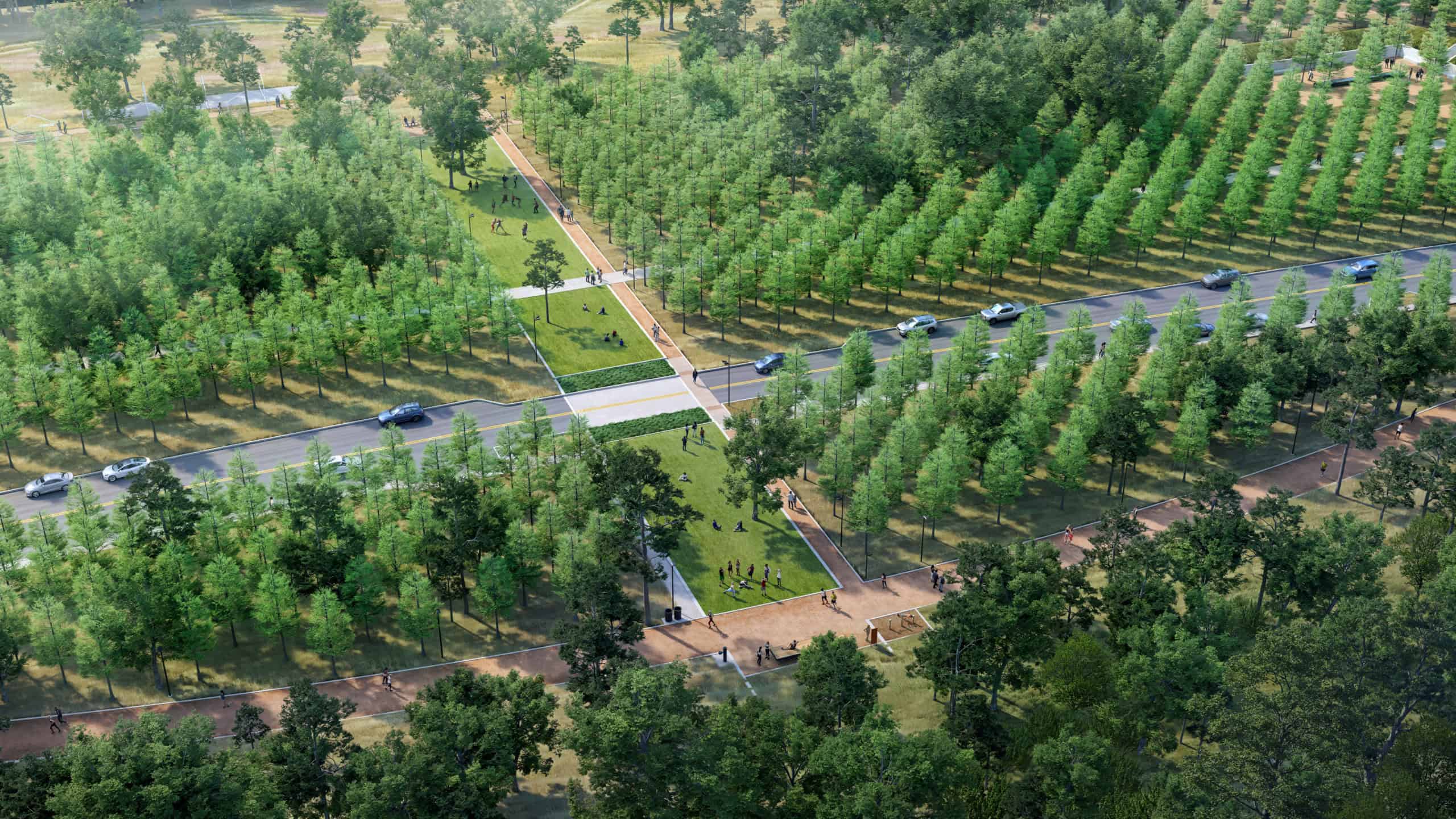
Covering twenty continuous acres along both sides of West Memorial Loop Drive, interrupted only by the regular rhythm of the open lawns marking Camp Logan’s historic streets, the groves of trees will provide a palpable sense of the scale of Camp Logan where 70,000 soldiers trained for war.
As the bald cypress change colors with the seasons, visitors immersed within the groves, whether walking its paths or driving along Memorial Loop Drive, will be reminded of the soldiers and their sacrifice, while being inspired by the beauty of the natural cycles of life and renewal.
A new Visitor Center designed by Moody Nolan will anchor the north end of Memorial Groves and will include offices for Memorial Park Conservancy. At the south end, a picnic pavilion, lawn area and playground will become a popular destination for families. Both areas will include new parking and restrooms.
Interpretive features, signage, and exhibits distributed throughout the Memorial Groves landscape and Visitor Center will engage both visitors and everyday Park users with the history of Camp Logan and the stories of individual soldiers who trained there. The center will also tell the stories of those who supported the camp, from the laborers who built the camp to the soldiers of the 24th Infantry Regiment who guarded its construction.
Enriching the Park User Experience
As with all other Master Plan projects, Memorial Groves will introduce new spaces for recreation and fitness, including trails for walking and cycling, adult workout areas, open lawns for play and picnicking, and a large playground with an adjacent covered pavilion. The playground will create a place where children can play and explore history simultaneously through age-appropriate themes animating a variety of play structures with elements of Camp life.
The playground will offer a one-of-a-kind experience where all ages and abilities can engage directly with the history of the Park through a series of unique play features, detailed by Earthscape, a custom playground company. Kids can climb up and into oversized soldiers’ helmets, army crates, and an enormous loaf of ‘hard bread’ each inscribed with insignias from WWI era. Another series of features includes a large bugle that appears to have blown over the adjacent log scramble and doubles as a talk tube for audio play. The playground is located near the new picnic pavilion and restroom, convenient to the new south parking lot, and nestled within existing trees for shade and comfort.
Seymour Lieberman Trail Enhancements
Significant enhancements will be made to (SLT) within the Memorial Groves project area, as was done in the Eastern Glades and Land Bridge projects. Approximately .7 miles (3,600 ft.) of the trail will be shifted further from West Memorial Loop Drive allowing Groves trees to be planted between the trail and the road. As the trees grow in, the result will be a more scenic and shaded route along the SLT, with the Camp Logan Historic Street Lawns extending across the road at regular intervals providing new grassy areas along the trail for gathering, stretching or resting adjacent to new fitness stations.
Memorial Groves Visitor Center
The new visitor center will anchor the primary entrance to the memorial landscape and will educate visitors on the story of WWI, Camp Logan and Memorial Groves. Designed by Moody Nolan, the structure creates a generous breezeway between the main exhibit space and new MPC offices, providing a welcoming threshold to the Groves beyond. The architectural materials and forms are shaped by the local climate, the Park’s architectural traditions, and a desire to bring in natural light and views to the landscape, allowing visitors to feel part of the environment indoors and out. Interpretive design and content of the interior space is spearheaded by Gallagher & Associates, in collaboration with project design lead Nelson Byrd Woltz Landscape Architects (NBW). New Camp Logan historic markers at select entry points to Memorial Groves and the Park will be provided by Texas Historical Commission and included in THC’s official statewide marker database.
Fulfilling the Vision of the Park’s Founders
When completed, Memorial Groves will be a unique, engaging and interactive memorial landscape connecting visitors to the diverse, complex, and untold history of Camp Logan; the role of Houston in WWI; and the lives and sacrifices of the soldiers who trained there. All will understand why the Park is fittingly named Memorial Park.
Construction is slated to begin in 2026, with project completion late 2027.
ABOUT THE TEN-YEAR PLAN
Memorial Groves is one of several Memorial Park Master Plan projects to be delivered on an accelerated schedule known as the Ten-Year Plan, made possible by a catalyst gift from Kinder Foundation and support from other generous donors. Both the Master Plan and its accelerated Ten-Year Plan projects promote connectivity and resiliency, restore damaged ecologies to provide higher function for the Park and city, help manage storm water, provide new cultural and recreational amenities, and tell the historical narratives of the people and the land through landscape design.
Memorial Park Conservancy is delivering the Ten-Year Plan projects with its project partners: Houston Parks and Recreation Department, Uptown Houston, and Kinder Foundation. Other completed Ten-Year Plan projects include the 100-acre Clay Family Eastern Glades (opened July 2020); the Sports Complex (opened October 2020); a one-mile segment of the Seymour Lieberman Trail that is now off of Memorial Drive and is an exciting run through the trees and over ravines (opened October 2022); the 100-acre Kinder Land Bridge and Cyvia and Melvyn Wolff Prairie (opened February 2023); and the Running Complex (opened November 2023).
Ten-Year Plan Project Partners:
Memorial Park Conservancy
Houston Parks & Recreation Department
Uptown Houston
Kinder Foundation
Master Plan Design and Project Landscape Architect:
Nelson Byrd Woltz Landscape Architects
Memorial Groves Project Team:
Blackland Collaborative
Dally + Associates
Design Distill
Todd Watson, PhD
Jeffrey Sammons, PhD
English + Associates Architects
Gallagher & Associates
Gandy2 Lighting Design
Gray & Pape, Inc
Jensen Hughes
Minor Design
Moody Nolan
Studio Pacifica
SiteWorks
Teliosity
Tellepsen
Texas Environmental Irrigation Design
PUBLIC INFORMATION SESSIONS
Memorial Park Conservancy, along with project partners, held two public information sessions for the Memorial Groves project. These information sessions provided the design team with important feedback and the opportunity to address questions and concerns during the development of the design.
The initial session, held on September 10, 2024, introduced the public to the history of the Park and the project’s conceptual design. The second meeting, which took place on February 13, 2025, presented the project’s schematic design.
Attendees were encouraged to ask questions at each session, and both discussions were fully recorded and made available online.
Click here to watch.
PARK UPDATES & ALERTS
Please be aware: The parking lots at the Running Complex and Picnic Loop will close each night at 9:00 p.m. and will reopen the following morning at 4:30 a.m.
The automatic gates allow free exit, meaning that any park user still in the lot after closing time can leave once the lot is closed.
The western portion of Outer Loop Trail will remain closed until 2027 for the construction of Memorial Groves.